
DSCR Loans Explained: Finance Investment Properties on Rental Income
A DSCR loan lets a real estate investor qualify based on what a property earns—not what they personally earn. No W-2s, no tax returns, no employment verification. The property's rental income does the qualifying work.
DSCR stands for Debt Service Coverage Ratio. It measures whether a property generates enough rental income to cover its own mortgage payment. Traditional mortgages qualify on personal income—salary, W-2s, and tax returns. DSCR loans flip that logic: the property's income is what matters, and your personal income is largely irrelevant.
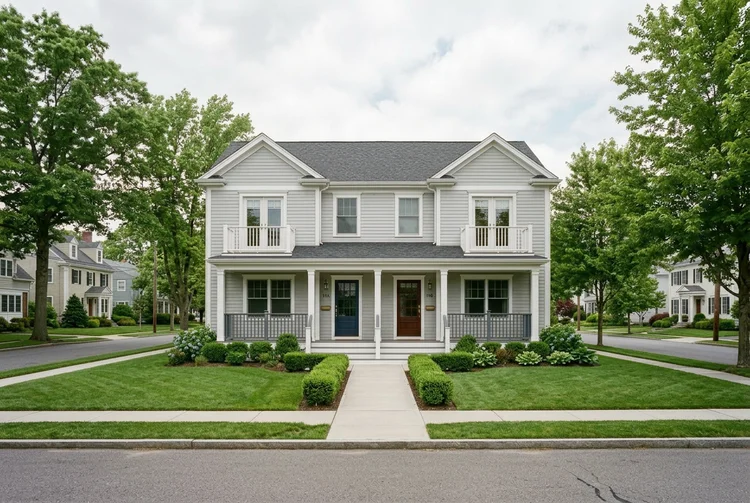
This makes DSCR popular with self-employed borrowers, landlords who write off significant expenses, and investors who own multiple properties and have income pictures that don't translate cleanly to a conventional application.
How the ratio is calculated
The formula is: DSCR = Gross Monthly Rent ÷ Monthly PITIA. PITIA is principal, interest, taxes, insurance, and HOA fees if applicable.
Example: a rental property brings in $2,400/month. The proposed mortgage payment is $2,000/month. DSCR = $2,400 ÷ $2,000 = 1.20. The property earns 20% more than it costs to carry.
A DSCR below 1.0 means rent doesn't cover the payment—the investor subsidizes the shortfall out of pocket every month. Most lenders set their minimum at 1.0 or 1.1. A handful of non-QM lenders will go as low as 0.75, but expect higher rates and stricter credit requirements. If no lease exists yet—new construction or a vacant property—lenders often use an appraiser's market rent estimate from the 1007 Rent Schedule form instead.
Typical loan requirements
Requirements vary by lender, but most fall into these ranges:
- Minimum DSCR: 1.0–1.25 (some lenders allow 0.75 with compensating factors)
- Credit score: 620 minimum; 680+ for better pricing
- Down payment: 20–25% on a purchase
- Loan amounts: typically $100K–$3M+, varies by lender
- Property types: single-family, 2–4 units, condos, short-term rentals
- Loan purpose: purchase, rate-term refinance, or cash-out refinance
- Interest rate: typically 1–2.5% above comparable conventional rates
- Prepayment penalty: common; usually a 3–5 year step-down structure
DSCR loans and non-QM financing
Most DSCR products are non-QM (non-qualified mortgage) loans. Non-QM is a broad category for mortgages that fall outside the Fannie Mae and Freddie Mac guidelines that govern conventional lending. They aren't subprime—they're simply underwritten differently, using alternative income documentation instead of the standard W-2 and tax-return review.
DSCR is the most common non-QM product for real estate investors, but it sits alongside several related loan types worth knowing:
- Bank statement loans — qualify on 12–24 months of deposits rather than tax returns; popular with self-employed borrowers buying primary residences or investment properties
- No-ratio DSCR — a variant where the lender skips the ratio calculation entirely and qualifies solely on credit, equity, and reserves; used when a property is vacant or mid-renovation
- Asset-depletion loans — income is imputed from liquid assets; no employment required
- Foreign national loans — designed for non-U.S. residents without domestic credit history; often DSCR-based by structure
Because non-QM lenders hold these loans in portfolio or sell them to private investors rather than Fannie or Freddie, guidelines and pricing vary widely between lenders. Rates run higher than conventional—but for borrowers who can't document income the traditional way, a no-income verification mortgage like DSCR is often the only practical path to financing a rental property.
Who DSCR loans work well for
- Self-employed investors whose write-offs make taxable income look lower than actual cash flow
- Landlords scaling a portfolio—conventional lenders cap financed properties at 10; most DSCR lenders have no cap
- Short-term rental operators who can document Airbnb or VRBO income
- Foreign nationals without U.S. credit history or domestic employment records
- Investors who need speed—no income docs means some DSCR lenders can close in 2–3 weeks
When a DSCR loan probably isn't the right fit
- You plan to live in the property—DSCR is for non-owner-occupied investments only
- The property cash-flows negatively; a sub-1.0 DSCR signals the investment may not pencil out regardless of how you finance it
- You qualify easily for a conventional loan—the lower rate will likely save meaningful money over time
- You need a low down payment—there are no FHA, VA, or USDA equivalents in this space
Key risks to understand
DSCR loans solve a real problem for investors, but they come with trade-offs worth modeling carefully before you commit.
Higher interest cost over time. A 1–2% rate premium on a $300,000 loan adds $180–$360/month and tens of thousands over a 30-year term. Confirm the property still cash-flows after accounting for the higher rate.
Prepayment penalties. Most DSCR loans carry a step-down penalty—for example, 5% of the loan balance in year one, dropping by 1% each year. Selling or refinancing early can be costly. Factor your exit timeline into lender selection.
Vacancy risk. The loan qualifies on expected rent, not guaranteed rent. If the property sits vacant for a few months, you cover the full payment out of pocket. Plan for 3–6 months of PITIA in liquid reserves before closing.
Lender variability. DSCR is not a standardized government-backed product. Minimum DSCR thresholds, rate sheets, and guidelines differ significantly between lenders. Shop at least three before committing.
How to put your best application forward
- Target a DSCR of 1.25 or higher—a stronger ratio unlocks better rates and more lender options
- Put 25% down; a larger down payment lowers PITIA and boosts the ratio
- Get your credit score to 720+; even moving from 660 to 700 can shave 0.25–0.5% off the rate
- Use a signed long-term lease over short-term rental projections when possible—it's the cleanest income documentation
- Build 6 months of PITIA in reserves; many lenders require it and it can offset a borderline DSCR
- Compare prepayment penalty terms, not just rates—if you're likely to sell in three years, a 3-year step-down is meaningfully better than a 5-year term
Ready to explore financing options?
Whether you're buying your first rental or expanding a portfolio, understanding your loan options is the first step. See how payments change by loan amount and rate, or connect with a lender who works with investment properties.