
Build on Your Land with $0 Cash Down
Use your land equity to satisfy the FHA 3.5% down payment requirement. Combined with an FHA construction loan, you can start building with $0 cash out of pocket.
Check Eligibility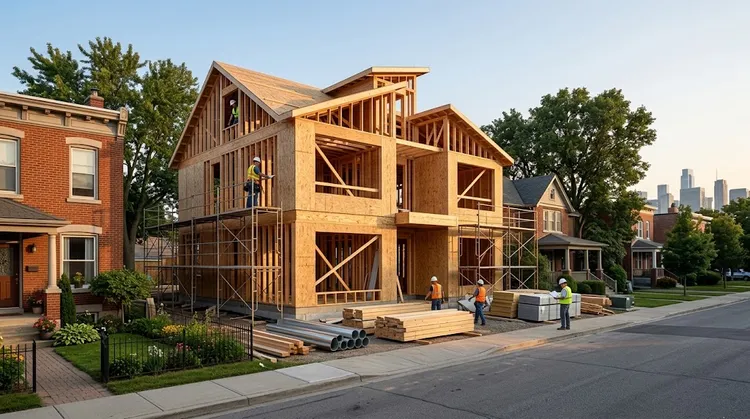
$0 Cash Down FHA Construction-to-Permanent Loan at a Glance
100% Appraised Land Value Credited
Owned your lot for 6+ months? Full market value counts directly toward your down payment.
Covers FHA 3.5% MRI
Land Equity Satisfies HUD's Minimum Required Investment without touching your savings.
Single-Close Loan Structure
One closing covers both your land equity credit and your home construction.
Connect with an FHA Lender
How to Get a $0 Cash Down FHA Construction Loan
Unlike USDA or VA loans, FHA does not waive the mandatory down payment. FHA lets you use existing land equity in place of cash, so you can finance a single-close construction loan without paying 3.5% out of pocket.
Find a Builder
Any licensed and insured contractor will satisfy the requirements, but what lenders look for most is a builder who has already completed a similar project.
Cover FHA's 3.5% With Land Equity
Section 203(b) requires a 3.5% down payment in cash or equity. If you have owned the lot for 6+ months, FHA credits 100% of the appraised land value toward that requirement.
Close with $0 Cash Out of Pocket
The builder contributes up to 6% of the loan toward closing costs and the deal can close as a true $0 out-of-pocket transaction.
“The Borrower may utilize any cash investment in the Acquisition Cost of the Property or land equity to satisfy the Minimum Required Investment (MRI).”
Building Instant Equity with Owned Land
When you pledge land you already own as collateral for an FHA construction loan, you do not just eliminate out-of-pocket cash. You unlock instant equity. By combining your land with a licensed builder and managing the project, the final appraised value of your completed home routinely exceeds the combined cost of the land and construction.
Sign a Build Contract
- Build Contract
- $400,000
- Required 3.5% Down
- $14,000
The build contract should be written to cover closing costs up to 6% of the loan.
Finance Build Contract With $0 Cash Down
- Build Contract
- $400,000
- Land Value
- +$20,000
- Total Project Basis
- $420,000
The land value acts as the $0 down payment, covering the 3.5% down $14,000 FHA requirement.
Unlock Instant Equity & Appreciation
- Final Build Appraised Value
- $460,000
- Build Contract
- -$400,000
- Financed Upfront MIP (1.75%)
- -$7,000
- Net Equity at Move-In
- $53,000
The finished home typically appraises higher than the land value and cost of construction. The additional equity represents the value you added to the property by arranging the build.
The Land Equity Advantage
Your land acts as your down payment, so you finance 100% of the construction without touching cash savings. When the home is done, the gap between build cost and the higher appraised value is equity that belongs to you. USDA $0 down stops at the city line. FHA $0 cash down on a lot you already own is the pathway to an urban real estate empire: turn in-town land into a finished home, bank the equity, and start from an asset instead of a vacant parcel. FHA still charges MIP: 1.75% upfront (usually financed) plus a monthly premium. Land equity does not waive those.
Is this hard to do?
It is a more involved process than buying an existing home, but it favors all involved players. The key is getting an experienced broker who will work for you.
The government
FHA is backing these loans because the government is trying to solve the housing crisis and create land-owning taxpayers with a vested interest in their community.
Brokers
Brokers who know construction-to-permanent are happy to do the extra work. New construction usually means a higher loan amount than an existing home, so the brokers get fairly compensated for the extra work even while offering competitive rates.
Lenders
Lenders love new construction loans for the same reason brokers do. The loan amount is higher than an existing home. They are typically the most experienced party on this product. The bottleneck is usually a broker who has not yet built a strong relationship with lenders experienced in these loans.
Builders
Builders love new construction. It is the easiest type of work compared with expansions or renovations. They have full control of the site and do not have to work around what someone else did before them. A licensed general contractor with a similar finished home on their resume is what makes the rest of the table comfortable.
You, as the owner
You get a finished home worth more than the land plus the cost of construction, with $0 cash down if the land equity covers FHA's 3.5%. Oversee the project yourself and you get the same benefits the big builders do.
Do not give up after a denial
If you have been denied in the past and have land equity, do not give up. The key is finding a broker who is looking to work for you with the right wholesale lender relationships, not just looking to close the fastest deal. Even if you were denied after matching through Budget Sidekick, fill out the form again and match with a different broker until someone will figure the deal out and put in the work. You need land equity to put up and a willingness to find an experienced builder. Do not let one broker who lacks the correct wholesale lender relationships put you out of building your real estate empire.
The FHA Program Explained In Detail
FHA construction-to-permanent loans are insured by the Federal Housing Administration, an agency of the U.S. Department of Housing and Urban Development (HUD). There is no separate “zero-down FHA product.” This is FHA Section 203(b) Construction to Permanent. One closing, land equity for the 3.5%, then the loan converts to a 30-year FHA mortgage when the home is done.
Construction to Permanent
HUD Handbook 4000.1 II.A.8.j · one-time close
One closing before the build starts. The loan funds construction draws, then converts to a 30-year FHA mortgage when the home is done. You must already own the land or buy it at that same closing. Land equity counts toward the 3.5%.
- Licensed general contractor required (owner-build only if you are a licensed GC)
- Primary residence, not a second home or investment property
- Total of land + construction within the county FHA limit
What this does not skip
- FHA mortgage insurance still applies: 1.75% upfront MIP (usually financed into the loan) plus annual MIP paid monthly. With less than 10% down, monthly MIP typically lasts the life of the loan.
- Closing costs, prepaids, and escrow are fees to the lender, title company, and tax collector, not the down payment. When you search for a builder, find one willing to pay those closing costs. FHA allows a builder to contribute up to 6% of the loan toward those costs. Builders are incentivized to do so, but they need to know ahead of time so that they can write it into the initial contract.
- FHA does not finance vacant land by itself. The lot has to be part of building or buying a primary residence.
- Not every FHA lender offers construction-to-permanent. Ask before you sign a builder contract.
- Credit, DTI, occupancy, and county loan limits are the same as any other FHA loan (typically 580+ for 3.5%).
Related FHA & $0-down options
FHA construction
One-time close construction-to-permanent — the usual way to put land equity to work.
FHA loan overview
Rates, MIP, credit, and how a standard FHA purchase compares with conventional.
USDA construction
True $0 down in eligible rural and suburban areas — no land equity required if you qualify.
VA loans
Eligible veterans can finance 100% with no down payment and no monthly MIP.
Own a lot? See if FHA cash-to-close can be $0
Land equity can cover FHA’s 3.5%. Construction-to-permanent is more involved, so you need a broker who will work the file. The form above matches you with FHA-experienced brokers.
Connect with an FHA lender
NMLS-licensed lenders Fast Lender Matching No initial credit impact
Powered by Mortgage Research Center, NMLS #1907 — Trusted since 2002