
How to Find Affordable USDA-Eligible Homes Just Outside the City
USDA-eligible areas often start just past the city edge, where homes cost less and you can buy with $0 down. Learn how county income limits and the USDA map work, with a Raleigh to Harnett County example.

The idea: zero down, just past the city edge
A USDA Guaranteed loan lets you buy a home with no down payment. The catch is location: the home has to be in an area USDA considers rural. That sounds like a farmhouse an hour from anywhere, but in a lot of metros the eligible homes sit in the halo region just past the city edge. The map draws that region. It does not follow the county line. Income limits are the part set by county.
Those edge-of-the-metro towns are often where homes cost far less than in the city, while jobs, airports, and hospitals are still within a reasonable drive. If your household income fits the local limit, that combination of lower prices and $0 down can put a house within reach years sooner than saving 10% or 20% for a down payment.
The short version
- The property has to be in a USDA-eligible area. Check it on our USDA eligibility map.
- Your household income has to be under the limit for the county you are buying in.
- Start at the city edge and work outward until the map shows eligible areas.
How USDA income limits work
USDA sets the income limit by county (or by metro area, which is a group of counties). The limit that matters is the one for the county where the house is, not where you live or work today.
For fiscal year 2026, the national base limit is $122,800 for households of 1 to 4 people and $162,100 for households of 5 to 8 people, effective July 13, 2026 (USDA Rural Development announcement). No county is lower than the base. Higher-cost metros get higher limits, because the limit is tied to local incomes. You can look up any area on our USDA income limits by ZIP page or on rd.usda.gov.
That means a county with a big-city salary base can have a high limit, while the cheaper county next door sits at the base. That detail matters in the example below.
Which income counts
USDA counts the income of every adult in the household, not just the people on the loan. A working adult child or a partner who is not borrowing still counts (USDA Handbook HB-1-3555, Chapter 9).
The limit is tested against adjusted income, after these deductions:
- $500 per dependent (minor children, and full-time students or adults with a disability who live with you)
- $550 per elderly household (the head of household or spouse is 62 or older, or has a disability)
- Child care for children 12 and under, so an adult can work or go to school
- Medical expenses above a threshold, for elderly households and household members with a disability
The $500 and $550 amounts are current as of August 4, 2026 (USDA Rural Development notice).
What makes an area eligible
USDA uses its own definition of rural, based on population and census data (HB-1-3555, Chapter 12). In broad terms:
- Places with populations under about 10,000 are generally eligible.
- Places of 10,000 to 20,000 can qualify if they are outside a metro area and lack mortgage credit.
- Some places up to 35,000 that were eligible before stay eligible until later census data is applied.
The boundaries do not follow city limits or county lines. One part of a town can be eligible while another is not. Close-in suburbs are usually part of the city's urbanized area and are not eligible, so the opportunity is typically a little farther out.
How to find eligible areas on our USDA map
The fastest way to spot the opportunity is our USDA eligibility map. It shows both halves of the question on one map: which areas are likely eligible, and how high the income limit is in each county.
- Open the USDA eligibility map and enter a ZIP code near the city you work in. The map zooms into that state and highlights the ZIP.
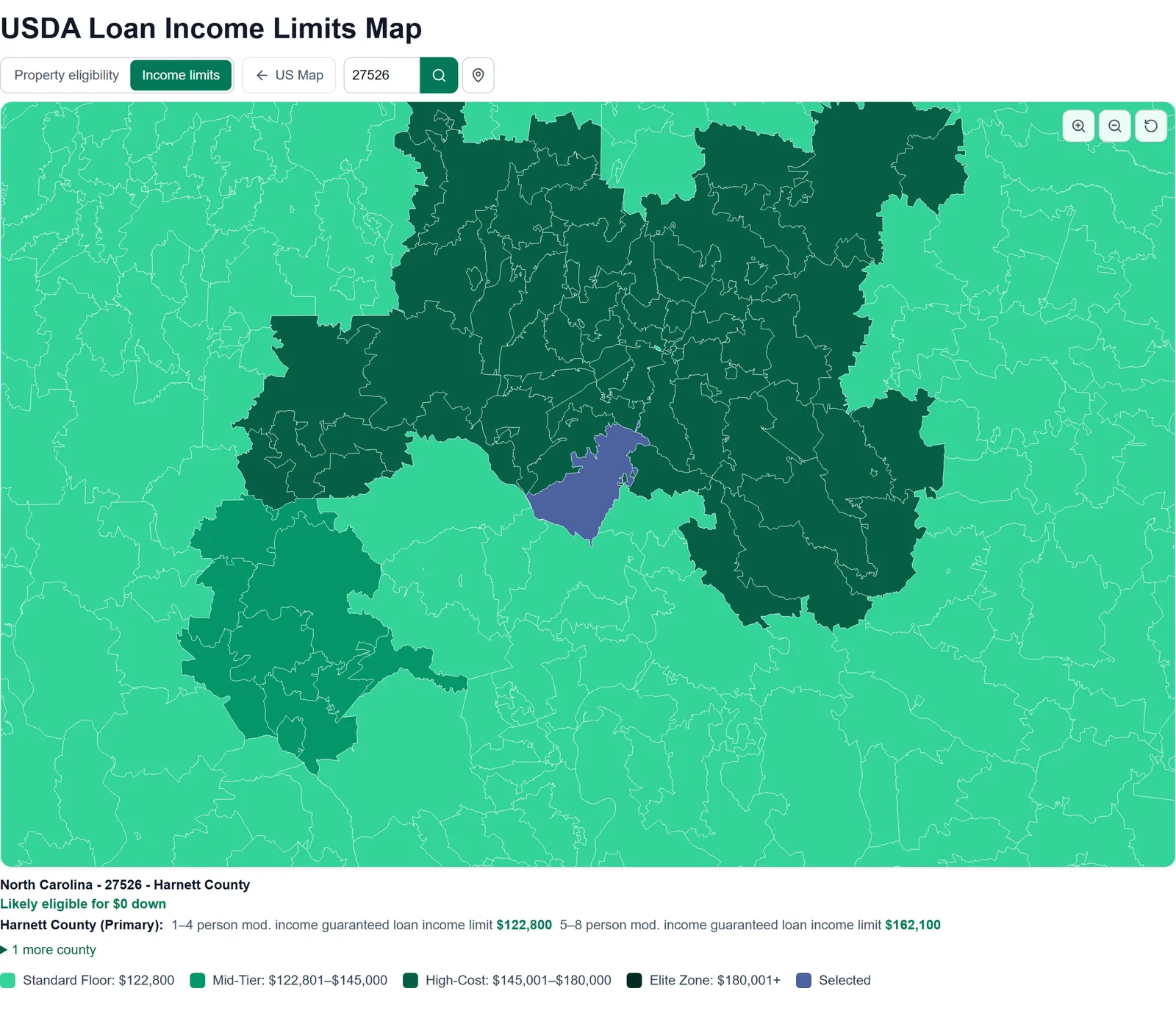
- Switch to the Income limits view. Each county is shaded by its income tier, from the national base of $122,800 up through Mid-Tier, High-Cost, and Elite Zone. Big-city counties stand out in the darker high-cost tiers.
- Work outward from the city. Look for the neighboring counties that drop to the base tier. Those are often where home prices drop too.
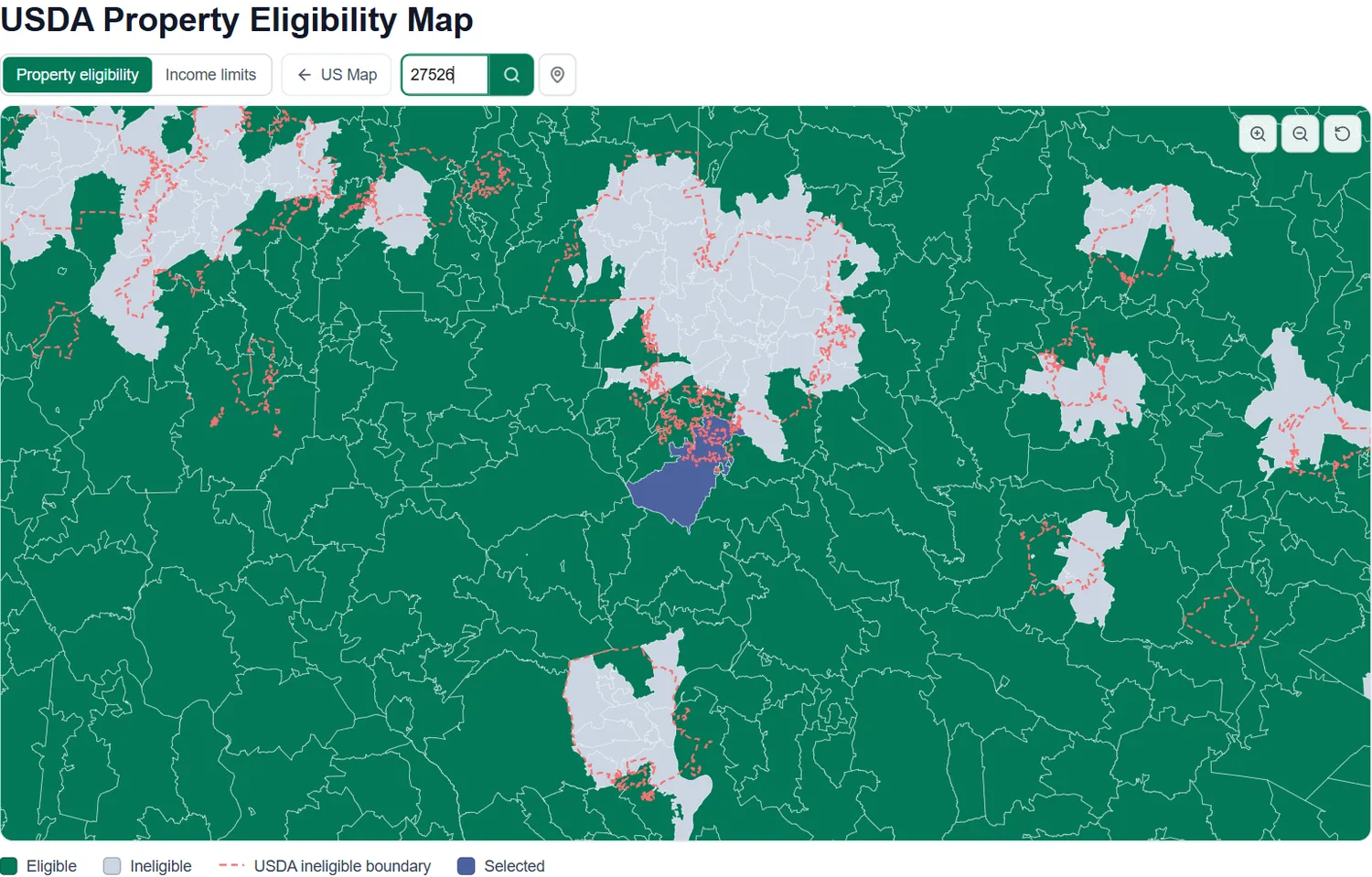
- Switch to Property eligibility. Light gray areas are ineligible, usually the city and its close-in suburbs. Everything else is likely eligible. Click a ZIP to see its status and its income limits for 1 to 4 and 5 to 8 people.
Find eligible areas near your city on our map
Confirm the exact address on USDA's official map
Our map estimates eligibility by ZIP code. USDA scores the exact property, and one ZIP can include both eligible and ineligible addresses. Once you have a specific home in mind:
- Open the USDA property eligibility map (Single Family Housing Guaranteed) and click Accept.
- Type the address into Find Your Address and press GO!
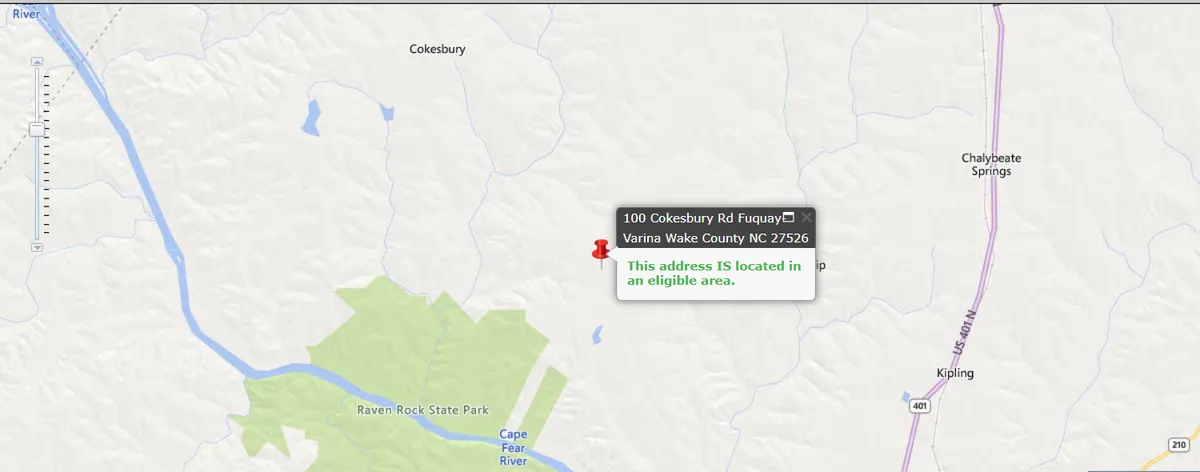
- The pop-up tells you whether the address is in an eligible area.
How to check your income
Look up the limit for any ZIP on our USDA income limits by ZIP page. To test your own household, including deductions, use USDA's official income tool:
- Open the USDA income eligibility tool and choose the state and county of the home, not where you live now.
- Enter the number of people in the household, how many are under 18, and whether anyone is elderly or has a disability.
- Enter monthly income for each adult and any annual child care or medical costs. The tool asks for monthly pay, then annualizes it.
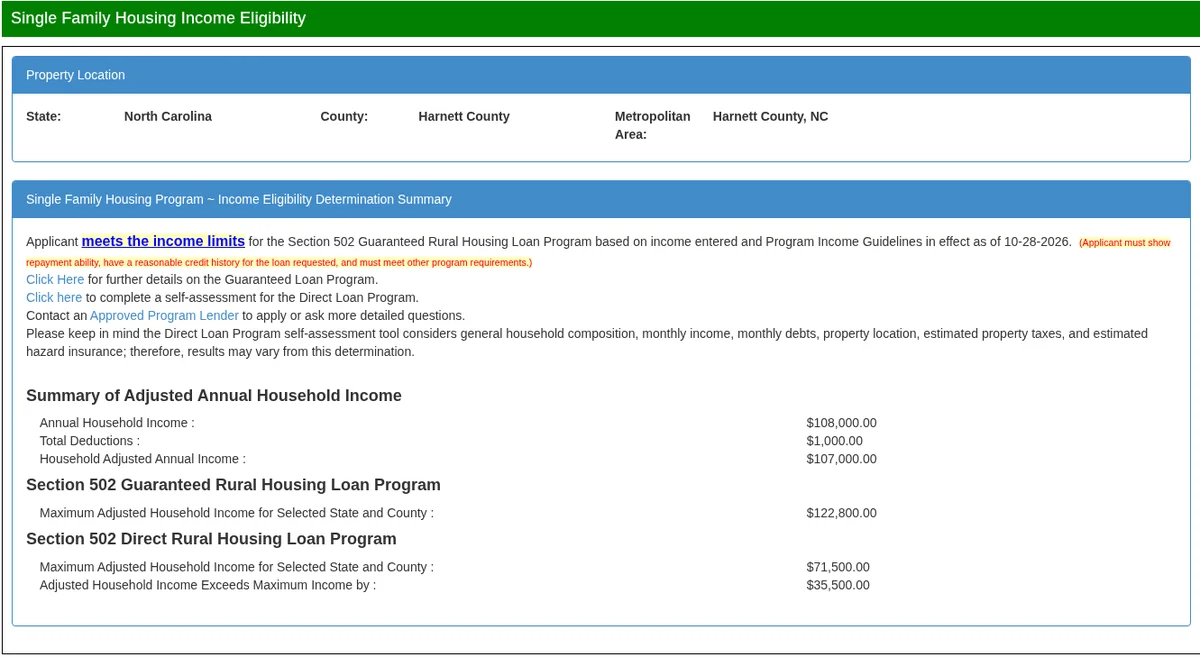
- Click Finish. The summary shows your adjusted income next to the county limit.
Worked example: Raleigh to Fuquay-Varina, NC
Raleigh is in Wake County, one of the fastest-growing and priciest housing markets in North Carolina. On our map, the Raleigh area sits in the darker High-Cost income tier, and Raleigh and its close-in suburbs show as ineligible. Search Fuquay-Varina's ZIP, 27526, and the map changes: the ZIP straddles Wake and Harnett counties, its primary county is Harnett at the $122,800 national base, and most of it shows as likely eligible. Farther south, Harnett towns like Lillington, Angier, and Dunn are likely eligible too.
| Wake County (Raleigh) | Harnett County (south Fuquay-Varina) | |
|---|---|---|
| USDA income limit (1 to 4 people) | $152,600 | $122,800 (national base) |
| Median owner-occupied home value | About $461,000 | About $246,000 |
| USDA-eligible areas | Raleigh and close-in suburbs: no | Harnett side of ZIP 27526, plus Lillington, Angier, Dunn: yes |
Home values: U.S. Census Bureau QuickFacts for Wake County and Harnett County (American Community Survey 5-year estimates). Eligibility: Budget Sidekick USDA map and USDA's official property map, checked October 28, 2026.
Downtown Fuquay-Varina is about 16 miles from downtown Raleigh in a straight line, and the eligible Harnett side of the ZIP is about 23 miles out. Lillington, the Harnett County seat, is about 28 miles away. The median home value in Harnett is close to half of Wake's. On a USDA loan, a buyer could put $0 down on a home there instead of saving tens of thousands of dollars for a down payment on a pricier home in the city.
Harnett is the county to notice because its limit sits on the national floor, $122,800. USDA does not publish a lower cap. A county on that floor has local median income in the lowest band the program uses, so the cost of living is expected to be lower than in a county with a higher limit, such as Wake at $152,600. The floor is not a raise on top of Harnett's incomes. It is the sign those incomes are already at the bottom of the scale. Other eligible counties in a city's halo often still carry that higher limit. Higher limit, higher local median income, and a higher cost of living is what to expect there. Harnett is the halo county in this drive that has already fallen to the floor.
This is also why you confirm the exact address. On USDA's official map, 131 S Main St in downtown Fuquay-Varina is not eligible, while 100 Cokesbury Rd and 5050 Christian Light Rd, on the Harnett County side of the same ZIP, are eligible.
The find is not the whole county. Lillington, Angier, and Dunn sit on the same floor and are eligible, and they are farther from Raleigh. ZIP 27526 is the niche: close enough that the eligibility line already cuts through it. A jagged line through one ZIP is the sign the fringe has been found. The search to run first is a floor-income halo that is still fully eligible, before that line shows up.
Note the income limit. Wake's limit is $152,600, but if the house is in Harnett, the Harnett limit of $122,800 applies, even if you work in Raleigh.
Watch-outs
- The cheaper county often has the lower limit. If you earn a big-city salary, you may be over the limit where the house is. Two adults earning $65,000 each make $130,000, which is over Harnett's $122,800 limit for a household of up to four, unless deductions bring adjusted income down far enough.
- Count the commute. Gas, tolls, vehicle wear, and time add up. Price a realistic monthly commute before you decide the savings are worth it.
- The map is not a final answer. The map and income tool are screening tools. USDA makes the final property determination when your lender submits a complete application, and you still need acceptable credit and the ability to repay.
- Boundaries change. Eligible areas are updated as new census data is applied. Check the exact address before you make an offer.
Common questions
Are USDA loans only for farms or very remote areas?
Who sets the USDA income limit?
Whose income counts toward the limit?
Is a suburb right next to the city eligible?
If a map says an address is eligible, am I approved?
Next steps
Find eligible areas on our USDA map
You may qualify for $0 down on a home that costs much less than one in the city. Find out in a few minutes:
- Check an address on our USDA eligibility map
- Look up the county limit on USDA income limits by ZIP
- Get a personalized USDA eligibility check
- Learn the basics in USDA Guaranteed Loan Explained